
Europe's Security Risks in an Age of Strategic Uncertainty

Updated: Jul 19
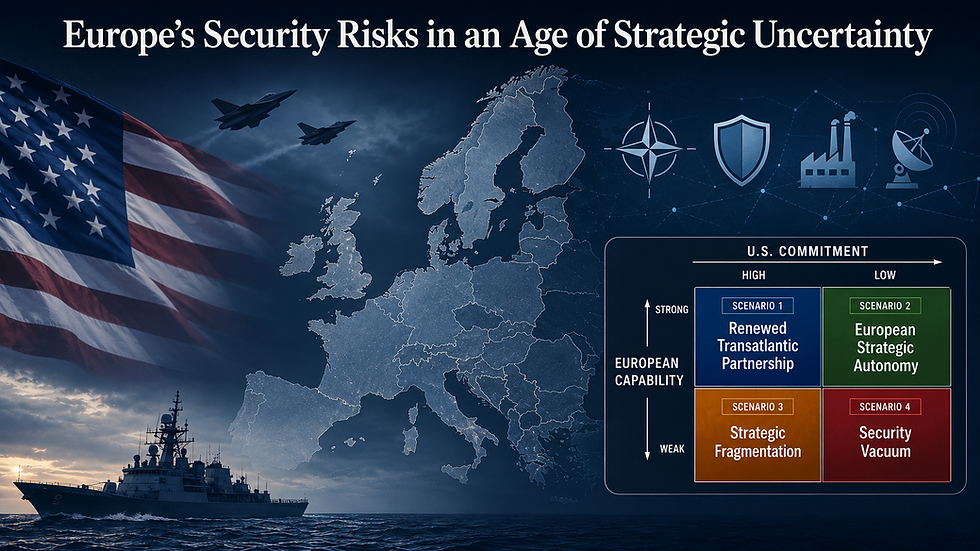
A New Question for Europe:
Since the end of World War Two, European security has relied on the assumption that the US would remain the principal guarantor of continental defence. In 1949, NATO’s formation integrated the American armed forces into Europe’s security framework. Although individual European states maintained their militaries, collective defence relied heavily on Washington's willingness to act. That assumption is being challenged by shifting priorities and an evolving geopolitical environment.
The US faces multiple geostrategic challenges, from Russia’s war in Ukraine, Middle East tensions, and the rise of China. Meanwhile, European states debate over the degree to which they should provide for their own defence. Complete American withdrawal from the European security framework is not the primary risk facing Europe. Instead, it is the uncertainty over the future level of commitment from America, which may impact deterrence, forcing European states to rethink their security strategy. Alliances are not only dependent on overwhelming military capability, but also their credibility. If NATO members are unsure whether their ally’s commitment to Article 5 will be honoured, deterrence is weakened. Uncertainty can become detrimental.
Europe's Strategic Vulnerability:
Europe’s main hazard is uncertainty regarding America’s commitment to European security.
This uncertainty comes with a number of risks:
Declined credibility of NATO deterrence
Increased Russian military pressure on Europe
Strained European defence budgets
Internal division regarding the future of European defence strategy.
The potential harm weakens Europe's collective security, in a scenario where NATO doesn’t even have to dissolve.
Why Now?:
Three developments have increased uncertainty:
Russia’s invasion of Ukraine dramatically changed the way Europe thinks about
security. It was a key moment that represented the return of conventional military threats to the continent, particularly to those most vulnerable in Eastern Europe. However, overwhelming American support for Ukraine through the provision of aid, intelligence and arms highlighted Europe’s dependence on their ally across the Atlantic.
China remains the biggest long-term threat to American hegemony. The US diverting its attention to the Indo-Pacific theatre suggests that European security may no longer be America’s highest priority.
European states have repeatedly committed to increasing defence spending following the invasion of Ukraine. However, increased budgets don’t simply convert into enhanced military capability.
Despite increased spending, Europe continues to face challenges including:
Reliance on US technology, intelligence and logistics;
Contrasting state-level threat perceptions;
Divided opinions on the future of European defence
While increased defence expenditure is a positive, the key is that such spending is accurately converted into military prowess.
Scenario Analysis - Europe's Security Future:
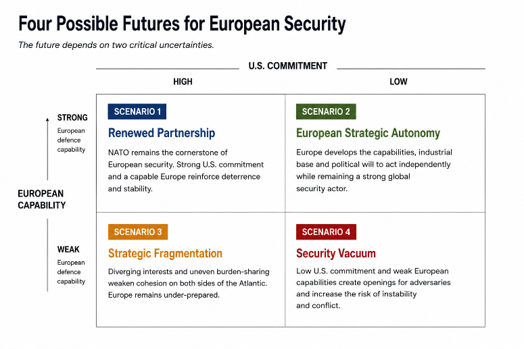
The two critical uncertainties are:
Level of American commitment to European security
Europe's ability to develop independent defence capabilities
Scenario 1 - Renewed Transatlantic Partnership: High US commitment + Strong European defence development
This represents the most stable, and arguably the most positive scenario. The US remains engaged in European defence, while simultaneously European countries invest in their capabilities at a national and continental level. NATO continues to operate, but Europe takes a more assertive role in the alliance.
Impact:
NATO remains credible, if not stronger;
European defensive capabilities develop;
Russian deterrence improves.
Scenario 2 - European Strategic Autonomy: Lower US commitment + Successful European adaptation
In this scenario, uncertainty regarding US commitment results in Europe moving towards greater strategic autonomy by improving its military capabilities. NATO doesn’t have to dissolve, but the US may no longer be the dominant security provider that it once was within the alliance.
Possible developments:
Deepened defence cooperation amongst European states;
Development of a European defence and dual-use industrial base;
Increased European interoperability.
Of course, division amongst European states regarding their individual approach to security would remain the biggest hurdle to overcome.
Scenario 3 - Strategic Fragmentation: Lower US commitment + Weak European response
Under these conditions, the absence of strong American leadership results in European states failing to come together to form a collective approach to continental defence.
Possible consequences:
Differing state-level security strategies;
Weakened alliance cohesion and interoperability;
Increased vulnerability to external threats.
Scenario 4 - The Security Vacuum: Major US disengagement + European inability to compensate
This represents the highest-impact scenario. A weakened NATO alliance could encourage hostile actors to test the reliability of the transcontinental security system. Here, NATO still exists, but the Article 5 commitment becomes politically contested and deterrence is no longer credible.
Potential consequences:
Pressure on Europe’s eastern flank;
Increase in hybrid attacks;
Confidence in collective defence deteriorates.
Low Probability - High Impact Events:
Although unlikely, these ‘black swan’ events could dramatically alter the landscape of European security:
Direct NATO-Russia confrontation;
Major US-China escalation diverting US resources and attention;
Collapse of political stability in a major NATO member OR Russia;
What to watch:
The following developments may indicate increased risk to European security:
Russian military activity near NATO borders;
Reduced US military deployments in Europe
Permanent US deployments in the Indo-Pacific;
Changes to American and European defence budgets;
Further European division, failure to implement NATO/ EU capability measures;
Diversion of American military priorities.
Conclusion - Europe's Challenge is Managing Uncertainty:
The future of European security is plagued by uncertainty. For decades, Europeans largely assumed American commitment to their security was permanent. However, that assumption is becoming less certain, and American support can no longer be taken for granted. Ultimately, this has forced Europe to reconsider their responsibility in defending the continent, and how the burden should be shared.
It would be unwise to suggest that the result is extreme, either total dependence on Washington, or complete separation from it. However, with such uncertainty, Europe needs to accelerate the development of its own capabilities and become a stronger pillar within the NATO alliance. Therefore, the question for Europe isn’t ‘will America abandon us?’, rather, ‘can we maintain our security should American commitment become less predictable?’


Comments