
False Maps, Tangled Borders: Can Armenia and Azerbaijan Trade Their Way to Peace?


As our bus wound its way through the mountains of Armenia, our young tour guide asked us to open Google Maps and check our location. To our surprise, the map showed that we were in Karki, an Azerbaijani exclave.
“Maps are lying,” the young lady declared.
She explained that many tourists became anxious upon discovering where they were, fearing for their safety. “This is Tigranashen. There are Armenian villagers living here, and the main highway connecting northern and southern Armenia runs through this area. You are perfectly safe.” The region is under Armenia’s de facto control.
This is true. How much of the truth can a map actually tell us?
The concept of false maps is gaining higher exposure lately. On 4 September 2026, the United Nations General Assembly adopted a resolution promoting the Equal Earth projection as an alternative to the 16th-century Mercator projection, which significantly distorts the relative sizes of continents, particularly Africa. The problem extends beyond geographical proportions. Gearóid Ó Tuathail and John Agnew (1992) argued that geopolitical representations do not merely describe political reality. They also shape how we perceive places, peoples and international relations, often obscuring the complexities of life on the ground.
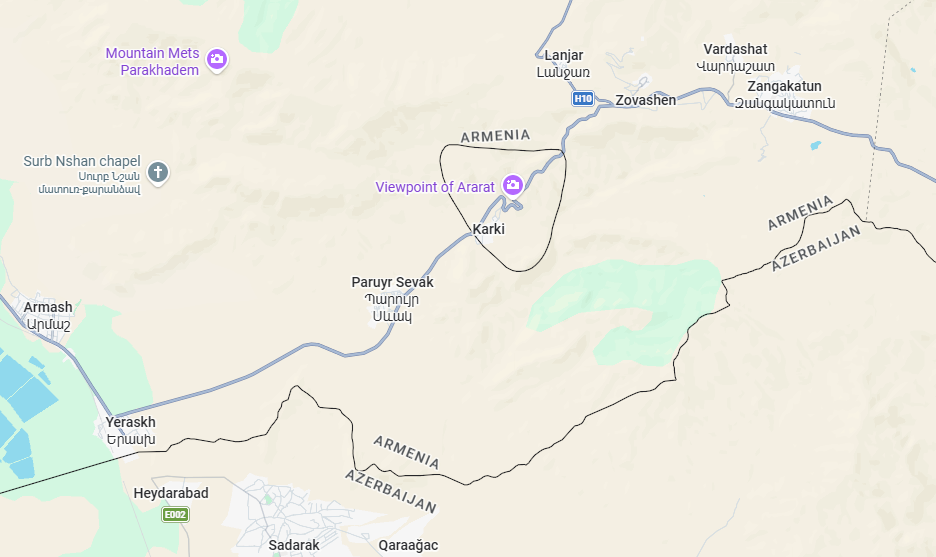

The enclave issue between Armenia and Azerbaijan dates back to the 1920s, when the Kavburo (Caucasus Bureau of the Communist Party) sought to balance representation among nationalities by assigning settlements to Soviet republics based on their ethnic composition. These decisions, driven by political and ethnic considerations rather than geographic reality, created isolated territorial pockets within the Transcaucasian Soviet Federative Socialist Republic (TSFSR).
The enclaves remain a legacy of Soviet-era administrative border-making, leaving Armenia and Azerbaijan embroiled in a bloody struggle over territorial integrity.
On 20 September 2026, Armenian Prime Minister Nikol Pashinyan reaffirmed that border delimitation with Azerbaijan would follow the 1991 Alma-Ata Declaration, which recognizes former Soviet administrative boundaries as interstate borders. He stressed that outstanding territorial issues must be resolved peacefully, through mutually acceptable arrangements that consider local residents.

A similar approach has emerged in Central Asia, where Uzbekistan and Kyrgyzstan have used territorial exchanges to resolve longstanding disputes inherited from Soviet-era border-making. In 2022, the two countries agreed to a deal granting Kyrgyzstan nearly 19,700 hectares of disputed land in exchange for Uzbekistan gaining control of the Kempir-Abad reservoir. More recently, in 2026, two Kyrgyz villages with approximately 2,500 residents were transferred from Uzbekistan to Kyrgyzstan in exchange for several hundred hectares of land intended to improve Uzbekistan’s transport network. These agreements demonstrate how territorial exchanges can facilitate border delimitation, although concerns over access to water and local livelihoods remain.
References:


Comments