
Ten Years On: Has the South China Sea Arbitration Changed Anything?

Introduction
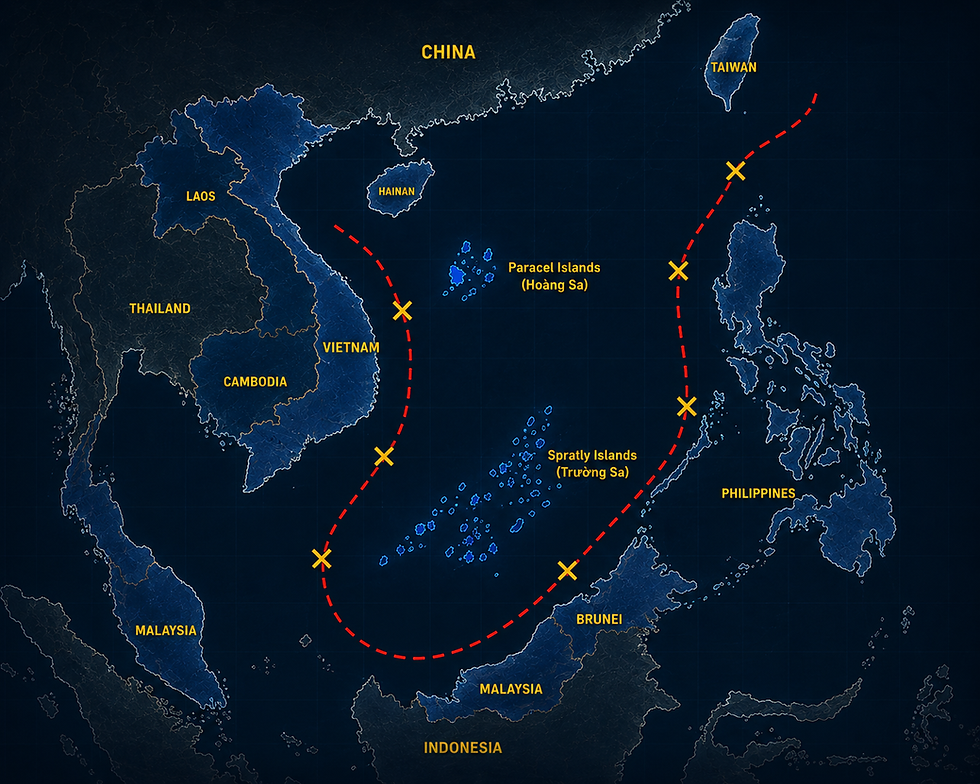
July 12th, 2026, marked the ten-year anniversary of the South China Sea Arbitration, one of the most important rulings in contemporary maritime law. In 2016, the Permanent Court of Arbitration in The Hague found that China’s ‘Nine-Dash Line’ and maritime claims in the South China Sea had no legal basis under the United Nations Convention on the Law of the Sea (UNCLOS). The Philippines, which initially brought the case to court, won decisively, representing a reaffirmation of a rules-based international order.
However, a decade later, the South China Sea remains one of the world’s most contested regions, and a potential future flashpoint. China has rejected the ruling and maintains extensive claims to the area. Military activity has increased as states seek to project power throughout the region, with confrontations with Filipino vessels being a common occurrence.
Thus, the anniversary of the ruling raises a broader geopolitical question: if international law has settled the legal dispute, why has it failed to settle the strategic one, and has it altered the geopolitical reality of the South China Sea?
Why the South China Sea Matters
There are a multitude of reasons as to why the South China Sea holds so much strategic value. It is estimated that up to one third of global maritime trade passes through the sea, linking East Asian economies, particularly China, with the rest of the world. China’s claim to the majority of the waters is framed through the lens of state sovereignty, national security and geostrategic depth. Conversely, China’s claims inhibit neighbouring states’ access to natural resources and territorial integrity. From a geopolitical perspective, the United States views it as an issue of freedom of navigation and maintaining the balance of power in the Indo-Pacific. Thus, due to the importance of the South China Sea, the region has become one of the most strategically significant maritime spaces in the world.
The Limits of International Law
The 2016 arbitration case did not examine the sovereignty of the disputed islands in the sea. Instead, it assessed the legitimacy of China’s claims in accordance with international law. In the end, it was determined that China's "Nine-Dash Line" not only had no legal foundation under UNCLOS, but it also infringed upon the Philippines’ sovereign rights. China’s rejection of the ruling has allowed it to continue its expansive practices.
The tribunal exposed a fundamental issue with international law. It determined that China’s actions contradicted international law, but they could not enforce this ruling. Unlike domestic law, international law relies upon nation states to respect and adhere to their decisions. When legal obligations conflict with national interests, adherence to international law often becomes secondary, with little, if any, repercussions.
A decade later, the South China Sea dispute highlights the gap between geopolitical realities and legal legitimacy. Since the tribunal’s findings, China continues to enforce its claims through artificial island building and military patrols, to expand its de facto control over disputed waters. On the other hand, the Philippines has pursued closer defence cooperation with the United States, while Washington continues to conduct ‘Freedom of Navigation’ Operations to counter China’s excessive maritime claims. This reflects the harsh reality of geopolitics. International law can indeed impact legitimacy and diplomatic support, but it cannot force great powers to alter their strategic actions. The effectiveness of international law ultimately depends on cooperation and political will, not legal authority by itself.
Looking Ahead
The strategic importance of the South China Sea will not disappear in the near future. As great power competition between China and the United States escalates, the region will continue to reflect broader geopolitical competition. The security environment in the sea will be shaped by continued confrontations between Chinese and Philippine vessels and strengthened security ties between the United States and its allies in the region. Ultimately, it is up to the key actors, rather than international law or the Hague, to balance geopolitical gain with restraint to ensure the South China Sea dispute doesn’t evolve into a more serious crisis.
Conclusion
As the South China Sea Arbitration marks its tenth anniversary, the region is still one of the most hotly contested maritime territories in the world. The tribunal was indeed successful in determining that China’s maritime claims lacked legal basis under UNCLOS, but it ultimately failed to resolve the dispute entirely. Hence, the sea highlights both the strengths and shortcomings of international law. As great-power competition returns to the fold, the challenge does not lie in determining what actions are lawful, but rather whether states are determined to act to defend such law.


Comments