
The STC in Yemen is taking over, but what does that mean?

Since the Arab Spring in 2011, Yemen has been embroiled in disorder and tragedy. The rise of the Houthi group, who challenged the central government and seized power in Sanaa in 2014, continues to wreak havoc. The amount of destruction that multiple civil wars in the last several decades has generated unfathomable destruction and health crises but the entire story is much more complex as it ripples across several countries in the Middle East. Powerful state and non-state actors use Yemen as a proxy for a power struggle over the Middle East region and it seems that the recent actions from the Southern Transition Council (STC) has ignited long-standing internal Yemeni grievances as well as an increasing power struggle between the Kingdom of Saudi Arabia and the United Arab Emirates.
Some historical context is needed to understand how Yemen has reached this flash point, but the following is not comprehensive in the complex story of the Yemeni people. Starting with the military coup in 1974 in North Yemen, a powerful political faction arose from two assassinations and the election of Ali Abdullah Saleh by the People’s Constituent Assembly. After several attempts to unify with South Yemen, Saleh was ultimately successful in May of 1990. The unification process was very eventful over the next twenty years that included a full blown civil war as well as questions surrounding the validity of nationwide elections and amending the constitution to lengthen Saleh’s position as president. As other countries struggled with the same problem across the Middle East and North African nations, the Arab Spring impacted Yemen with Saleh resigning from office in November 2011. Throughout all of the internal political problems, there were several outside forces attempting to influence the Yemeni government and they are still deeply integrated today.
Yemen’s closest neighbour the Kingdom of Saudi Arabia (KSA), who is known to oppose both republics as well as the unification of the two states. While Yemen was still divided, the Saudis used a “divide and rule” concept of funding rival tribal leaders and central authorities to keep the two sides from joining forces. Once the unification process was successful, the kingdom continued its support but only enough so that Yemen was not a threat. Today, the Saudis want to maintain a united Yemen and are openly supportive of the central government. Their support caused one of Yemen's most significant non-state actors and a prominent Shia group, who happens to be backed by Iran and their proxy groups. The spark that ignited this issue became a direct problem for KSA in 2000, when the Treaty of Jeddah outlined border demarcation as well as the disarmament of the Zaidi-Shia group Ansar Allah, who is also known as the Houthis. Several years later, the Houthis are in rebellion and the Yemeni government sends a request to the Saudis to help militarily. The limited intervention was not especially successful to put down the non-state actor but also “demonstrated Saudi military weakness, confirming widespread international belief of the overall capacity of Saudi forces.” When the next leader of KSA came into power, he was determined to show strength in the region so in March 2015, Operation Decisive Storm was launched. The Saudi-led coalition of Arab states, with the United Arab Emirates (UAE), Egypt, Morocco, Jordan, Bahrain, Sudan, and Kuwait, launched air strikes against Houthi targets, deployed small ground forces, and also imposed a naval blockade. The coalition also had backing from the United States. A month later, the coalition declared an end to the operation but continued to bomb known Houthi positions. The US also increased its military arms sales to the Saudis to continue the bombing campaign. Within the next few months, a new turning point in the Middle East begins to emerge when the UAE begins to back Yemen’s STC political and military group.
The rise of the STC comes from the chaos brought on by years of civil war and power struggles between state and non-state actors. The group officially organised in 2017 with a formal president, Aidarus al-Zubaidi (also the Vice President of Yemen), and several councils including armed units, tribal groups and businessmen. The STC group has a clear goal of secession where they want an independent Southern state. One of the biggest critiques of secession is how the state is weakened economically and politically due to the loss of territory. For Yemen to lose the southern territory along the Gulf of Aden will be astronomical but it is also why the UAE is so keen to support the STC. The Royal United Services Institute (RUSI) understands that the UAE’s interest in southern Yemen is a “key area of influence due to its resources and proximity to the Bab al-Mandeb Strait and major global shipping routes, placing it in a strong position to broaden its ambitions as a maritime security actor.” Looking at the following map below illustrates how much territory the STC has secured with support from the Emiratis.
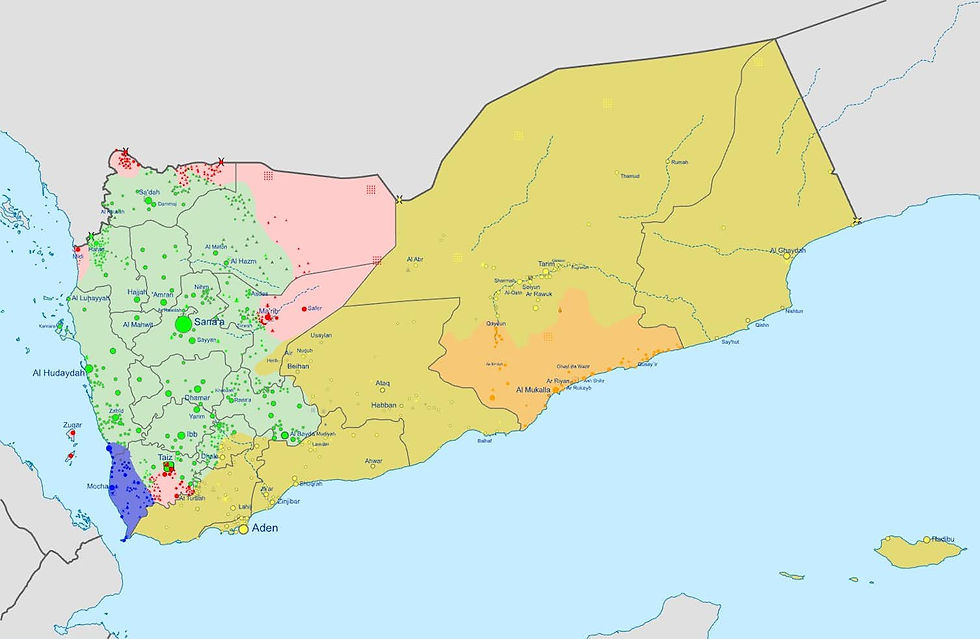
Pink or blue shaded areas depict territory controlled by the PLC or allied forces, yellow or orange depict territory controlled by the STC or allied forces, green depicts areas controlled by the Houthis. NordNordWest / Wikimedia Commons, CC BY-NC-SA
Officially the Emiratis claim that they are not supporting the STC but there are some international groups who believe that there is financial and military support to the group with an allocation of $1 billion to support the STC’s military campaign against the Houthis as well as providing military training and equipment to the STC. There is also some evidence that key “national infrastructure in southern Yemen is now guarded by men whose salaries, media platforms and external ties flow through Abu Dhabi.” Investing in a territory that is as volatile as Yemen is a huge risk but to have influence over the busiest maritime region is a worthy risk for the Emiratis.
In the last few weeks, major news outlets reported a new turning point for the STC. The group has taken significant territory with 10,000 troops taking over the oil-rich Hadramaut governorate as well as Marah, the less-populated governorate bordering Oman, which had not previously been under its control. It seems that with minimal fighting, the STC now controls all eight governorates that previously made up South Yemen. The Saudis are keen to keep a united Yemen but the takeover of the most important economic region of Yemen by the STC threatens the civil war stalemate. It can also be surmised that relations between the Saudis and the Emiratis are increasingly tense since they are on opposing sides of the proxy conflict. Western countries must be watching this relationship carefully as all parties involved in Yemen can spillover into any number of other countries in the Middle East.
There are several types of failed states but a new label can be added to this list from Chatham House called “Chaos State” and the definition is “a place where the central government has either collapsed or lost control of large segments of the territory over which it is nominally sovereign; and where a political economy has emerged in which groups with varying degrees of legitimacy cooperate and compete with one another.” It is important to examine that the large segments of territories are dissembling due to many internal and external groups working against each other and with each other at the same time. It is surely chaotic as the state is being used as a proxy for other nations to grow their influence over the region with limited regard to how they are achieving that power. The future of the STC and Yemen lies in the hands of others and how willing they are to support them. At this time, no one is calling for a declaration of statehood in southern Yemen but an important factor would mean formal recognition from another nation state. With so many state and non-state actors involved, they may have a long wait time for any sense of normality.


Comments